on Flavia Corpas
Dates: April 16, 23, 30, May 07, 14, 21 and 28, June 4
Tuesdays
Hour: 19h to 21h
Duration: 8 meetings
Audience: general interested parties
Investment: R $ 640,00
Classroom course
Course includes certificate at the end
Since its foundation by Freud, at the dawn of the 20th century, psychoanalysis has been intimately marked by art. The consequences of this articulation, which reverberate to this day, produced important effects on both fields.
It is Lacan, for example, who tells us that interpretation, in the analytical experience, must always be Marcel Duchamp's ready-made, which would avoid feeding the symptom with meaning (Lacan, 1974), supporting his criticism of the idea of interpretation as hermeneutics, indicating that interpretation must point to the limits of representation or language, that is, to the real, the impossible to represent.
Both Freud and Lacan moved towards artists and their works, allowing themselves to be questioned. It is also true that neither of them had the objective of creating a psychoanalytic aesthetic. These psychoanalysts are interested in the knowledge that each artist carries, and that they testify in their works, knowledge that they do not know they possess and that, despite this, they use to create.
This involves, together with these psychoanalysts, addressing what art teaches psychoanalysis, breaking with the idea of psychoanalysis applied to art and making valid the proposition of Freud and Lacan regarding the fact that the artist always precedes the analyst .
However, psychoanalysis can also make its contributions to the field of art. At least that's what French art philosopher Hubert Damisch reflects:
Lacan was the first to give us a definition of “tableau”, which is at the same time coherent and productive, by stating that the “tableau” is a function in which the subject would have to find its marks, to find them as such (as subject). Isn't it strange that we had to wait until the 2005th century to get a correct definition to answer the question “what is a 'tableau'?”. And isn’t it strange that we had to wait for psychoanalysis to give us a correct definition for this term?” (Damisch, XNUMX).
In the field of art, in addition to Damisch, the French philosopher, historian and art critic Didi-Huberman stand out as important names in dialogue with psychoanalysis.
It will be based on the reading of some of the works of the aforementioned authors, and also those of Freud and Lacan, that work will take place in the Art and Psychoanalysis Studio. Through them, we will also get closer to the concepts of psychoanalysis used by theorists, thus granting us some possible reading keys for such reflections.
The working method is inspired by the way a very specific device proposed by Lacan works, the cartel. Distinct from the study group, a cartel proposes, among other things that would be more related to its function and place within the field of psychoanalysis and analyst training, a different relationship with knowledge, which implies the desire of each participant and a question that will guide your participation in the studio. It is important, therefore, that everyone can define a question, before or during their journey in the studio. It is also desired that this question undergoes some development throughout the reading work, which could be the production of a text, a new question, a video, a photograph, in short, something that helps the participant locate an entry point, a route and possible arrival.
Agenda
Class 1 – Art and Psychoanalysis: a field of tension:
- Presentation of the course and its methodology
- What is Psychoanalysis? What is Art?
- Art and Psychoanalysis: historical context and the present day
Class 2 – Freud’s readings:
- Freud and the artists
- Freud and Jensen's Gradiva: learning from art
- Circumscribing an object: research and project development practice
Class 3 – Lacan’s readings:
- Lacan and the artists
- Lacan and Marguerite Duras: the artist who preceded the psychoanalyst
- Circumscribing an object: research and project development practice
Class 4 – Didi-Huberman and Psychoanalysis:
- Didi-Huberman and Psychoanalysis: the invention of hysteria in art
- Circumscribing an object: research and project development practice
Class 5 – Hubert Damisch and Psychoanalysis:
- Hubert Damisch and Psychoanalysis: the real and the feminine in art
- Circumscribing an object: research and project development practice
Class 6 – Art, Psychoanalysis and Feminisms
- “Womb of the world”: surrealism and feminism
- Circumscribing an object: research and project development practice
Class 7 – Art, Psychoanalysis and Madness
- Obravida: a reading about Bispo do Rosario
- Circumscribing an object: research and project development practice
Class 8 – Presentation of work
- Presentation and discussion of work developed by students
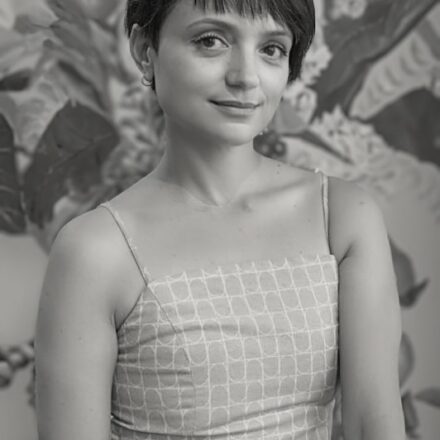
Flavia Corpas
MAM friend has 20% discount. Be part of it!
Students, teachers and retirees have a 10% discount
Doubts:
cursos@mam.org.br
WhatsApp: 11 99774 3987
By participating in this activity/event, you authorize, free of charge and definitively, MAM – Museu de Arte Moderna de São Paulo, to use your image, voice, biographical data and characteristic signs, captured in video, audio, photography and prints, for the purposes of recording, disseminating and promoting the Museum's activities, in any means, vehicles, supports, media, methods and technologies, tangible or intangible. If you do not want your image to be published, please inform MAM (cursos@mam.org.br).
credits
Untitled (1975), by Mira Schendel. | MAM São Paulo Collection